
Picture
FreeExpressProfessionalThe white shirt looks bright. Are the faces and fine details still usable?
Read the example →Learn & Reference
See a production problem and the result you can reach, then follow the steps on a prepared example. Expand Preparation when you need setup help.
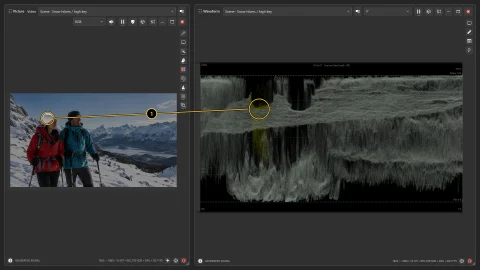
Build your first workspace and connect what you see in the picture with exposure and color measurements.
Start with a guided exercise →
Compare corresponding subjects, read exposure and color together, and follow compatible camera controls.
Try source comparison →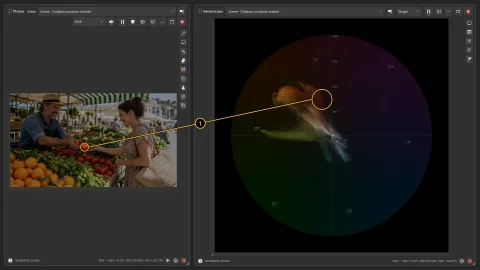
Explore snow, market, interior and stage examples, each chosen for a different exposure or color question.
Explore the practice scenes →
Let Shot Evaluator summarize the shot, then follow a helpful mark or card into the picture.
Explore Shot Evaluator →Choose the question you want to answer. Edition pills identify where each scope is included.
The white shirt looks bright. Are the faces and fine details still usable?
Read the example →
Two parts of the shot look differently exposed. Which subject is driving the trace?
Read the example → Explore the numbered picture →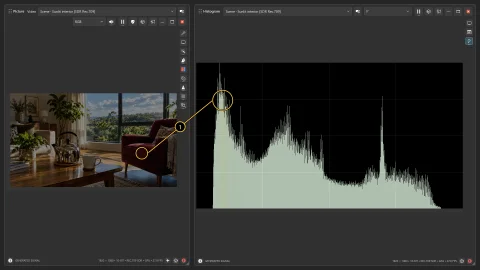
Bright clothing dominates the distribution and hides smaller tonal groups.
Read the example → Explore the numbered picture →
A camera has a subtle color cast that is hard to judge by eye.
Read the example → Explore the numbered picture →
You need the same color reference available in more than one pane.
Read the example →
Camera two makes the same studio subjects look warmer than camera one.
Read the example →
A colored object seems to be driving the imbalance in the whole-frame plot.
Read the example →
A whole-frame distribution hides the component relationship you need to inspect.
Read the example →
You need to understand which channel relationships deserve attention.
Read the example →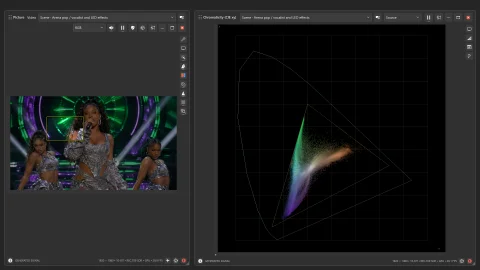
A saturated subject needs checking against the intended gamut reference.
Read the example →
Something in the sound changed while your attention was on the picture.
Read the example →
You need to repeat the same announcement without rewriting it each time.
Read the example →
You need a known signal before you can investigate an audio path.
Read the example →
The crew needs a source time reference alongside the picture.
Read the example →
Audio seems late, and you need a repeatable measurement before adjusting anything.
Read the example →
You looked away and need to see what the picture was doing a few seconds ago.
Read the example →
You need to tell how the level distribution changed during a moving shot.
Read the example →
A level changed while you were watching another part of the production.
Read the example →
Overlapping colors are hard to distinguish in a flat plot.
Read the example →
A bright HDR highlight is distracting you from the subject’s actual level.
Read the example →
A warning is visible, but you need to know which samples caused it.
Read the example →
A value near an edge changes depending on exactly where you sample.
Read the example →
You need to distinguish a source problem from the receiving path.
Read the example →
You need confidence that the recording can actually be opened after the show.
Read the example →
You need to check whether the expected caption words reach the picture.
Read the example →
A tally or metadata value changed while you were watching the shot.
Read the example →
You need a useful next check for an interview shot, rather than an unexplained verdict.
Read the example →Need help connecting an input? Open setup & troubleshooting. For grading, explore Color Grade & LUTs.
Explore the app · Camera matching and guided analysis · Choose an edition